

What Are the Types of Artificial Intelligence? A Simple Guide 2025
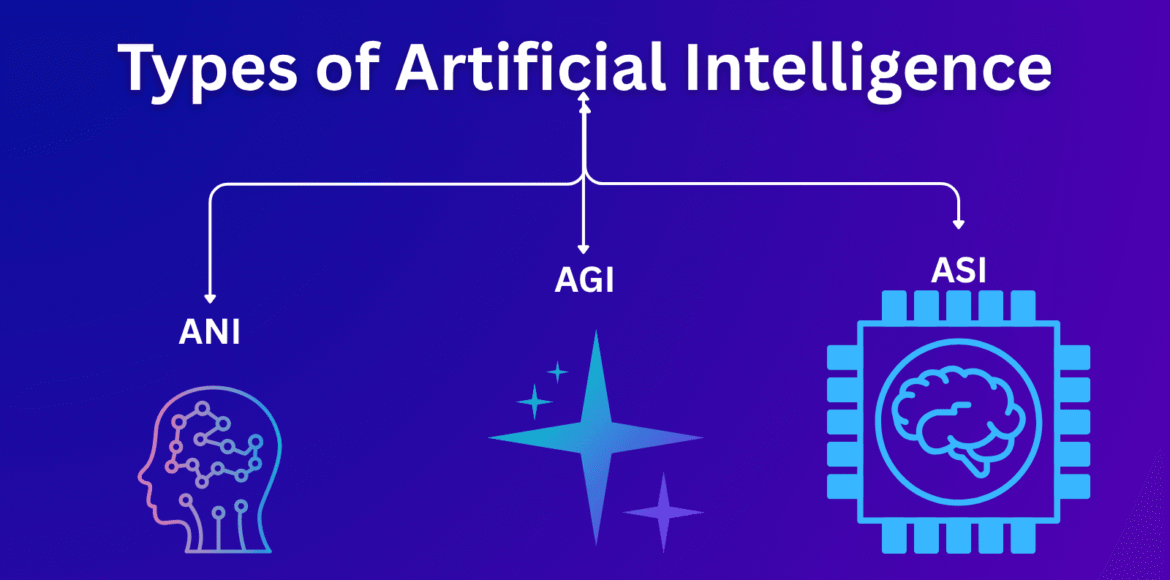
Trying to understand the different types of artificial intelligence can be confusing. For example, you hear “AI” used to describe your phone’s simple assistant and the algorithm that suggests movies on Netflix. In the same breath, people talk about hypothetical, world-ending robots in sci-fi movies. So, how can all these things fit under one umbrella?
Here’s the secret: they aren’t the same. The problem isn’t the term itself. Instead, it’s that “Artificial Intelligence” isn’t one single thing. It’s actually a vast computer science field. Because of this, most people get lost. They try to fit all types of artificial intelligence into one single box.
In reality, experts classify AI using two separate systems at the same time:
- Classification 1: By Capability (Its “Power” Level)
- Classification 2: By Functionality (Its “Mind”)
Once you understand these two lists, you’ll be able to categorize and understand any AI system you hear about. So, let’s break down both ways of classifying the types of artificial intelligence.
Classification 1: The Capability Types of Artificial Intelligence
This is the most common way to think about AI. It categorizes AI based on its potential power and generality. In essence, it’s like AI’s “career path,” from a simple specialist to an all-powerful being. This classification is also where we get the terms Weak vs. Strong AI.
1. Artificial Narrow Intelligence (ANI) – The Specialist
This is also known as “Weak AI,” but “Narrow” is a more accurate term. Put simply, ANI is an AI that is designed and trained to perform one specific task. It operates within a pre-defined range and cannot go beyond it. For example, think of it as a grandmaster chess player. They are a genius at chess, but you wouldn’t ask them to file your taxes or compose a symphony.
Here’s a key takeaway: when people discuss types of artificial intelligence in the real world, 99.9% of all AI in existence today is Artificial Narrow Intelligence.
- Real-World Examples of ANI:
- Chatbots & Generative AI: Yes, even advanced tools like ChatGPT are ANI. They are incredibly sophisticated at processing and generating language. However, they can’t access your camera, learn to drive a car, or feel emotions.
- Smartphone Assistants: This includes Siri, Alexa, and Google Assistant. They can set timers and search the web, but they can’t hold a real, contextual conversation about your day.
- Recommendation Engines: This is the AI that powers Netflix (“You watched Stranger Things, you might like…”), Amazon, and Spotify.
- Spam Filters: This is the original, unsung hero of ANI, quietly protecting your inbox.
- Facial Recognition: This is the software that unlocks your phone or tags you in a photo.
2. Artificial General Intelligence (AGI) – The Human-Level Thinker
This is “Strong AI.” When discussing the future types of artificial intelligence, AGI is often the main focus. It is a hypothetical, future-tense type of AI. An AGI would possess the ability to understand, learn, and apply its intelligence to solve any problem, just like a human being.
For instance, an AGI wouldn’t just play chess. It could learn to play chess, then learn to compose the music for the game’s soundtrack, and then write a marketing plan to sell the game, all by itself. In short, it has cognitive flexibility.
Status: AGI does not exist yet. It remains the holy grail of AI research. We are making incredible progress with complex ANI, but true, flexible AGI is still the domain of science fiction.
- Fictional Examples of AGI:
- Data from Star Trek: The Next Generation
- HAL 9000 in 2001: A Space Odyssey (though he’s a great example of AGI risks)
3. Artificial Superintelligence (ASI) – The “Beyond Human” Intellect
If AGI is AI at a human level, ASI is what comes next. This is a purely theoretical type of artificial intelligence. It wouldn’t just match human intelligence; it would dramatically surpass it.
In other words, an ASI would be more intelligent than the brightest human mind, or even the collective intelligence of all humans combined. As a result, it could solve problems in science, medicine, and engineering that are completely beyond our comprehension.
Status: Purely theoretical. This is the type of AI that inspires both the greatest hopes for humanity (curing all disease, solving climate change) and the greatest fears (the “Skynet” scenario).
Classification 2: The Functional Types of Artificial Intelligence
Now, let’s put the first list aside. This second system, proposed by researcher Arend Hintze, isn’t about power. Instead, it classifies types of artificial intelligence based on their functional ability. This refers to how they “think” and use data to make decisions. You can think of this as a more academic way to see AI, progressing from a simple reflex to full consciousness.
Type 1: Reactive Machines
This is the most basic type of artificial intelligence. It can react to a situation, but it has zero memory. Therefore, it cannot use past experiences to inform its current decisions. It just sees the board and makes the best move right now.
For example, think of playing a game of air hockey. You’re not thinking about the last game; you’re just reacting to where the puck is at this very second.
A famous real-world example is IBM’s Deep Blue. This was the computer that beat chess champion Garry Kasparov in the 1990s. It analyzed the current board and chose the optimal move, but it didn’t “remember” Kasparov’s past strategies.
Type 2: Limited Memory
This is where almost all modern AI systems live. As its name suggests, Limited Memory AI can look into the recent past to make decisions. However, the “memory” is transient. It isn’t saved into a library of experiences.
- Analogy: Driving a car. You need to remember the speed and position of the cars around you from the last few seconds to make a safe lane change. You don’t, however, need to remember every car you saw 10 minutes ago.
- Real-World Examples:
- Self-Driving Cars: They constantly observe their surroundings. This helps them build a short-term map of other cars, pedestrians, and traffic lights to navigate.
- Chatbots (like ChatGPT): They remember the last few lines of your conversation to maintain context. This is why you can ask follow-up questions. If you start a new chat, that memory is gone.
Type 3: Theory of Mind (In Development)
This is the next frontier of AI development and does not fully exist yet. This type of artificial intelligence would be able to understand human thoughts, emotions, beliefs, and intentions. Then, it could interact with them.
This isn’t just recognizing a frowny face. On the contrary, it’s understanding why you’re frowning and that you might believe something that the AI knows isn’t true. This is a core part of human social interaction.
- Status: In advanced research. We’re building AI that can recognize emotional cues, but truly understanding the “theory of mind” of another being is incredibly complex.
- Fictional Example: Sonny from the movie I, Robot, who can understand human intentions and emotions.
Type 4: Self-Awareness (Hypothetical)
This is the final stage of this model. Specifically, this AI would be an evolution of Theory of Mind. It would not only understand the consciousness of others but would also possess its own consciousness, sentience, and a sense of self.
- Status: Purely hypothetical. This is the stuff of deep philosophy and science fiction. We don’t even have a clear biological definition of consciousness, let alone a roadmap to build it in a machine.
- Fictional Example: Any AI in a movie that says “I am alive” and means it.
Putting It All Together: A Simple Cheat Sheet
So, how do these two classification systems for the types of artificial intelligence work together? It’s actually very simple:
- Today’s AI: The AI we use every day is Artificial Narrow Intelligence (ANI). This AI functions as a Limited Memory machine (or, in some cases, a Reactive Machine).
- The Future of AI: To create Artificial General Intelligence (AGI), researchers will almost certainly need to master Theory of Mind AI first.
For example, when you use ChatGPT, you’re interacting with an ANI (it’s a specialist) that uses a Limited Memory model (it remembers your chat). See? Simple.
A Final, Crucial Point: What About Machine Learning and Deep Learning?
You’ll also hear terms like “Machine Learning” (ML), “Deep Learning,” and “Generative AI.” So, are these more types of artificial intelligence?
The answer is no. Think of it this way:
- AI (Artificial Intelligence): This is the entire field of making machines smart.
- Machine Learning (ML): This is a method used to build AI. It’s the main skill we use, where we “teach” a computer by feeding it data instead of programming every single rule.
- Deep Learning: This is a more advanced, complex type of Machine Learning. It uses “neural networks” to solve very complex problems, like understanding speech or creating images.
- Generative AI (GenAI): This is an application of Deep Learning that can create new content (text, images, music) instead of just classifying it.
If ANI is the “job title” (e.g., “Email Spam Filter”), then Machine Learning is the “skill” it used to get that job (e.g., “Learned from 1 million spam emails”).
Your New Framework for Understanding the Types of Artificial Intelligence
You’ve got it! The next time you hear about a new “AI,” you can ask yourself two simple questions to understand it perfectly:
- What’s its Capability? Is it ANI (a specialist, like 99.9% of AI), AGI (a human-level thinker, which doesn’t exist), or ASI (a super-intellect, which is theoretical)?
- How does it Function? Is it a Reactive Machine (no memory), a Limited Memory machine (remembers the recent past, like most modern AI), or is it pushing into Theory of Mind (which is still in R&D)?
Ultimately, by arming yourself with this simple, two-part framework, you’ve just moved from a casual observer to an informed learner. You are now ready to discuss the different types of artificial intelligence confidently.
Frequently Asked Questions (FAQ)
What are the 3 main types of artificial intelligence?
This question usually refers to the 3 types of artificial intelligence by capability (or power):
- Artificial Narrow Intelligence (ANI): Specialist AI for one task (99% of today’s AI).
- Artificial General Intelligence (AGI): Hypothetical human-level AI.
- Artificial Superintelligence (ASI): Theoretical, “beyond human” AI.
What are the 4 main types of artificial intelligence?
This refers to the 4 types of artificial intelligence by functionality (or how they “think”):
- Reactive Machines: Reacts to current data, has no memory.
- Limited Memory: Uses recent past data to make decisions.
- Theory of Mind: (In-development) Understands human beliefs and emotions.
- Self-Awareness: (Hypothetical) A conscious, sentient AI.
Is ChatGPT considered one of the types of artificial intelligence?
Yes. Specifically, ChatGPT is a very powerful and advanced form of Artificial Narrow Intelligence (ANI). It is a specialist in language and code, but it cannot learn new domains, experience the world, or form independent goals. It operates as a Limited Memory machine.
What is the most common type of AI?
The most common (and currently, the only) type of AI we use every day is Artificial Narrow Intelligence (ANI). Most of these ANI systems use Limited Memory principles.
What is the difference between Weak AI and Strong AI?
These are just other names for the capability types. “Weak AI” is another name for Artificial Narrow Intelligence (ANI)—an AI that is limited to a single, specific task. “Strong AI” is another name for Artificial General Intelligence (AGI)—an AI with human-level cognitive abilities.

